

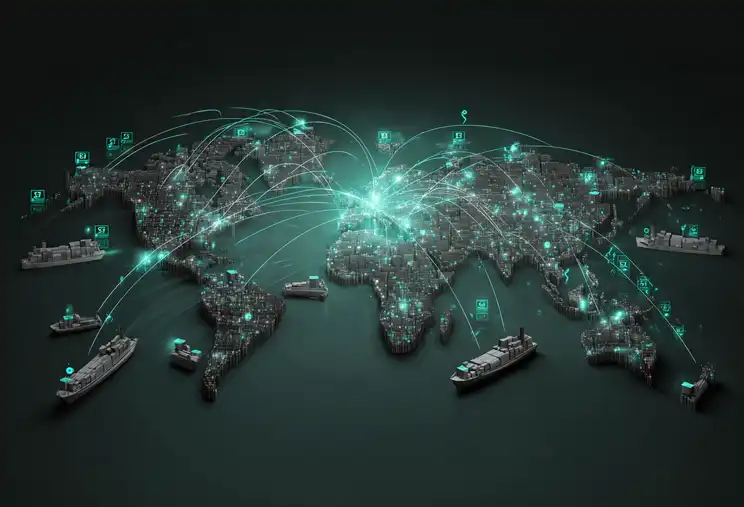
In September 2025, on the floor of Sibos in Frankfurt, Microsoft demoed something the trade finance industry had been talking about for twenty years. Working with HSBC, Lloyds, and ANZ, they showed a prototype where AI agents pulled trade data straight from a corporate ERP system, validated it against ICC data standards, and sent it digitally to banks. No paper. No re-keying. No 50-document avalanche. Just data.
Later, the four parties published a joint piece describing the work. It was, by their own description, proof of concept.
That phrase deserves more attention than it got.
A proof of concept proves the idea. Production proves the company.
This is true across every wave of trade finance modernization. The early electronic trade platforms of the 2000s, the consortium experiments of 2017–2020, today’s agentic AI demonstrations – each generation has done essential work in answering “can it work?” That question has to be answered first. It is the foundation that everything else is built on.
The next question is a different one: does it work, every day, for every transaction, in every jurisdiction, under every audit? That is not a smaller question or a less interesting one. It is simply a later one. And it tends to be answered by a different set of institutions, on a different timeline, with a different kind of work.
The Microsoft, HSBC, Lloyds and ANZ proof of concept is meaningful precisely because of what it settles. Three of the largest trade finance banks in the world, alongside Microsoft, have publicly committed to the architectural direction. That is a consensus. That is a turning point.
It is also the foundation. The next chapter is what gets built on top of it.
The infrastructure caught up faster than people noticed.
While the industry was running pilots, three things changed quietly underneath.
The UK’s Electronic Trade Documents Act, passed in 2023, ended a century of legal ambiguity by making electronic trade documents enforceable under English law. That single piece of legislation cleared the path for digital handling of roughly 60% of global trade finance and the lion’s share of shipping, insurance, and commodity trade routed through London.
The ICC’s Digital Standards Initiative published the Key Trade Documents and Data Elements framework, finally giving the industry a common data shape to map against. And the Digital Standards Initiative set a target: 60 to 80 percent of world trade digitalized by the end of 2026.
The legal layer is in place. The standards layer is in place. A vision-level architecture has been demonstrated by the largest names in the room. The question stops being “is this possible?” and starts being “who is ready to do it?”
What does “ready” actually mean?
Production-grade AI-native trade finance is not a slide. It is a list of unglamorous, fundamental things working together at the same time.
Document examination across UCP 600 and ISBP 821 with port alias resolution and semantic matching. AML screening that runs fuzzy matching across multiple sanctions lists in milliseconds. SWIFT message handling – MT700, MT707, MT760, MT400 – wired correctly, against the right Standards Release. Risk scoring that decomposes into factors a credit committee can interrogate. And underneath all of that, a governance layer that decides, transaction by transaction, when AI acts and when a human govern. Whether a transaction shape has been seen before matters. Production Governance is not a switch you flip – it is a structured protocol that earns progressive autom through measured performance, not configured trust. Banks that treat AI-native architecture as a five-year roadmap item will discover, around 2027, that their corporate clients have already migrated to banks that processed faster and closed cleaner.
From Pilot to Profit: Realizing ROI in Trade Finance Innovation
Pilots are an important first step in the agentic AI journey. They show that an agent can perform, that a use case has promise, and that a new model of work is possible. But in banking, pilot success alone does not create ROI. ROI begins when that capability can move into live operations safely, repeatedly, and at scale.
That shift cannot be achieved through just AI deployment alone. Real ROI comes from one thing: progressive autonomy with explainability built in – a model in which autonomy is introduced in stages, governed by evidence, bounded by policy, and supported by human oversight. This is what allows banks to scale AI confidently, without taking on unacceptable operational or regulatory risk.
Progressive autonomy matters because enterprise value is not created by isolated acts of intelligence. It is created when decisions are reliable, explainable, and repeatable across real workflows. The more critical the process, the more important it is that autonomy expands only as trust is earned.
AurionAI has mastered that bridge. Fintra Trade Finance is where it comes to life – an AI-native trade finance platform built on progressive autonomy at its core. Four gates govern every transaction: Confidence, Materiality, Regulatory, and Novelty. When all four are satisfied, work flows straight through. When one of them is not, human judgment steps in –with every action captured on an immutable audit trail and control always retained.
In this agentic AI era, that is how institutions move from promising pilots to measurable ROI: not by scaling autonomy indiscriminately, but by scaling it progressively, responsibly, and with confidence. That is the AurionAI advantage.
Ready to move from pilot to profit? See Fintra in action – Book Your Exclusive Demo
Author: Swamynathan Sankaran, Product Head Aurionpro Trade & Supply Chain and Nishant Srivastava, Product Marketing Manager Transaction Banking, Aurionpro Solutions.