
Somewhere right now, a hospital administrator in Singapore is trying to get MRI machines shipped from Munich. The equipment is ready. The supplier is ready. But the deal is stuck, buried under a mountain of bills of lading, letters of credit, and insurance documents across 20 entities with up to 5,000 data fields that all need to match perfectly.
One typo. One mismatched date. A $20 million medical shipment grinds to a halt.
This is trade finance in 2025. The financial engine authorizing 90% of global trade still runs, in many banks, on paper stacks and human document checkers.
Digitization Didn’t Fix the Problem. It Just Made PDFs.
Scanning paper into PDFs is not transformation. It’s theater. The cognitive load on human checkers remains identical. The error rate stays similar. You’ve just moved the problem from a filing cabinet to a screen.
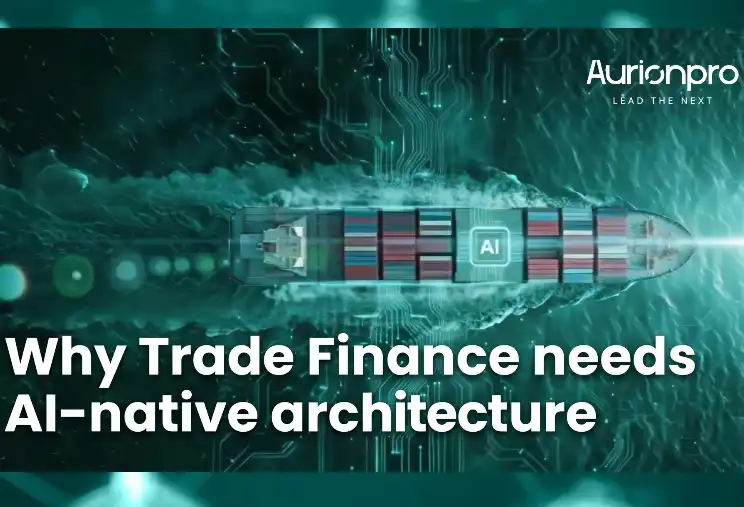
As trade volumes grow, revenue becomes directly tied to headcount. Need more business? Hire more document checkers. It’s a linear growth ceiling with no elegant exit, unless you rethink the architecture entirely. The difference between bolting a new engine onto an old ship versus building a speedboat from scratch.
AI-Native is Not the Same as AI-Assisted
Dropping an AI tool into a legacy process is a patch. An AI-native architecture means the entire data flow is designed around intelligence from the start. Suite of specialized AI agents work in parallel: extracting data, cross-checking document consistency, running AML screening, validating regulatory requirements, all coordinated by a central orchestrator.
When agents flag a discrepancy, the orchestrator runs it through four rigid gates: confidence, materiality, regulatory, and novelty. The materiality gate calculates risk relative to transaction context. A mismatched street name on a $500 shipment is not the same as one on a $50 million commodities deal. The system knows the difference.
Banks implementing this are seeing operational risk drop by over 68%, absorbing massive transaction volume spikes without proportional hiring.
Human Governance Is Built Into Every Layer
This is the part compliance officers and regulators rightly ask about: who stays accountable?
The answer is humans, at every critical junction. When any gate threshold is breached, the system stops and routes the transaction to a human reviewer with full context and flagged discrepancies. The human decides. The system executes. Above that sits a digital kill switch, where one decision by a senior risk officer can freeze the entire pipeline instantly during a geopolitical event or systemic anomaly.
Two governance layers, always active. AI handles the volume. Humans handle the judgment calls.
The Window Is Open, But Not Permanently
Corporate clients are already migrating toward banks that process faster and close cleaner. The institutions treating AI-native architecture as a five-year roadmap item will find the gap increasingly hard to close. Manual processes don’t just slow you down. At a certain scale, they become the ceiling.
The question is not whether this becomes the standard. It is whether your institution leads the shift or scrambles to catch up.
Ready to see it in action? Book a demo and explore how the agentic system handles your transaction workflows, compliance requirements, and volume projections.