

How Banking Software 2.0 Takes Over. Without Replacing Anything.
Software is dead, apparently. That’s the narrative everywhere, agents will replace applications, code will write itself, the entire stack as we know it is finished. I find myself disagreeing, and our point of view on Banking Software 2.0 will hopefully help us understand why.
Here’s what most people get wrong about the future of banking technology: they think existing systems are the problem. Tear out the core. Migrate the data. Re-platform everything. That story has been told for four decades, and it rarely ends well.
The truth is more nuanced. Banks will keep their cores, and they should. But the work will move. Agents will progressively absorb tasks that humans perform today on legacy systems. The systems themselves remain, but their role evolves, they become the execution rails and guardrails on which agents operate. Essential infrastructure, probably not the locus of daily work.
The real threat to legacy systems isn’t AI. It’s technical debt that prevents AI adoption. Systems that can adapt to support agentic execution will become more valuable, not less. Systems that cannot, will be routed around.
Banking Software 2.0 isn’t a replacement. Where feasible, it will be a layer on software 1.0, an agent layer that progressively takes over operations while using existing systems as its foundation. The core remains essential. The agents do the work.
The System of Record: Durable, Authoritative, Evolving
Banking Software 1.0 is what every bank runs today. It holds the balances, the contracts, the transactions, the regulatory data. It was built for durability, consistency, and auditability. These aren’t small virtues. They’re irreplaceable virtues.
The operating model is straightforward. Humans gather context. Humans key data. Humans validate. Humans decide. Then the system records and enforces. The software waits for instructions, it doesn’t initiate action, but it provides the authoritative foundation on which all action depends.
This foundation isn’t going away. Data gravity, workflow entrenchment, regulatory dependence, all of these create defensibility that no agent layer can simply bypass. But the tasks that humans perform on these systems will migrate, layer by layer, to agents. The system remains. The human operation of it fades in its current form.
Here’s where technical debt becomes the dividing line. Systems with clean APIs, well-documented logic, and stable interfaces will thrive as they become the guardrails that keep agents operating within bounds. Systems buried in spaghetti code and brittle integrations will struggle. Not because agents replace them, but because agents can’t use them.
The Agent Layer: Software That Acts on Solid Rails
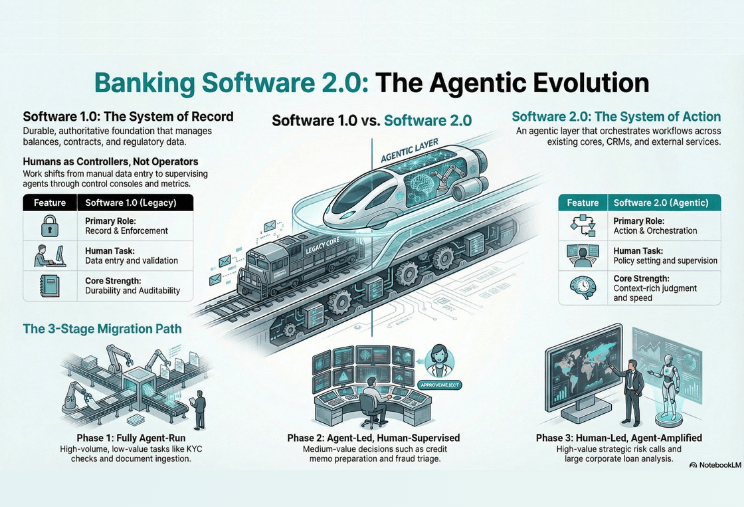
Banking Software 2.0 is different in kind, not degree. It’s a layer of agentic systems that read from, write to, and orchestrate across existing cores, loan origination systems, treasury platforms, CRMs, and external services. It doesn’t need to replace these systems, it depends on them.
These aren’t chatbots. They’re not point solutions. They’re operational actors that understand natural language requests, plan multi-step workflows across multiple systems, execute end-to-end, and escalate to humans only when required. Every action runs on rails that existing systems provide, within guardrails those systems enforce.
In architecture terms, you introduce three things: an agent orchestration platform connected to every system that matters, a policy and controls layer defining guardrails and approval thresholds, and a human-in-the-loop console where operators supervise agents instead of driving every click.
The shift is fundamental but symbiotic. Software 2.0 becomes a system of action. Software 1.0 remains the system of record and enforcement. Humans become controllers, not operators. And well-architected legacy systems actually increase in value, because agents need reliable rails to run on.
The Migration Path: Risk-Weighted, Value-Driven
Work will move in stages, mapped sharply to risk and value. This is how you implement Banking Software 2.0 while strengthening and not replacing the core software.
The first layer is high-volume, low-value work, fully agent-run. KYC checks, document ingestion, reconciliations, regulatory reporting prep. Repetitive, rules-based tasks where agents drive the interaction and humans stop logging in for routine work. You measure success in straight-through processing rates, cycle time reduction, and error rates. The core provides execution rails such as transaction APIs, validation rules, posting logic. Agents operate on these rails.
The second layer is medium-value decisions, agent-led, human-supervised. Credit memo preparation, covenant monitoring, fraud triage, exception handling. Agents assemble data, run models, and propose decisions with evidence attached. Humans review and approve through a supervisor interface with clear guardrails. The system of record provides existing guardrails such as approval thresholds, limit structures, regulatory constraints. Agents recommend. The core enforces.
The third layer is high-value decisions, human-led, agent-amplified. Large corporate loans, portfolio decisions, strategic risk calls. Agents run end-to-end analysis, scenarios, and impact simulations. Humans make the final call, but at a much higher level of abstraction and speed. The core provides both data foundation and execution certainty. The value here is cognitive leverage, built on trusted infrastructure.
The Real Inflection: Work Migrates, Value Concentrates
In early deployments, I don’t think there’s much choice for agent platforms to depend almost fully on existing systems. No data is duplicated. The core remains the system of record and enforcement.
As adoption matures, agents become the primary clients of the core, the LOS, the
treasury systems. Humans will likely stop interacting with these systems directly for most tasks. The daily work, the keying, the validation, the routine decisions, migrates to the agent layer. What remains in Software 1.0 is what it was always best at: authoritative data, transaction processing, general ledger, regulatory enforcement.
This is subtraction that adds value. Software 1.0 sheds tasks it was never optimized for and focuses on its core strengths. Software 2.0 absorbs operational complexity. The system of record becomes more reliable because it’s more narrowly focused. The system of action becomes possible because it has stable rails to run on.
Why 2.0 Absorbs Work, Not Systems
Historically, Banking Software 1.0 had to do two jobs: be the authoritative system of record and be the execution surface. The screens. The workflows. The clicks. It was never optimized for that second job, and that explains the operator frustrations as well as periodic attempts to refresh. It just had no choice.
Banking Software 2.0 gradually takes over that second job. Task by task, workflow by workflow, operational work migrates to the agent layer. The old systems continue as the system of record and enforcement, authoritative, auditable, compliant. But humans stop logging into them for daily work. Agents do.
This is how 2.0 eats 1.0 without replacing it. The legacy stack doesn’t disappear, it becomes specialized. Fewer screens, fewer workflows, but higher throughput on what remains. The agent layer handles the messy, context-rich, judgment-intensive work that 1.0 was never designed for. Both layers become more valuable together than either could be alone.
The exception, again, is technical debt. Systems that can’t expose clean interfaces, that require screen-scraping or manual workarounds, that break under increased API load will struggle. The adaptation required is real but bounded: clean APIs, stable contracts, capacity for higher throughput. Systems that make this investment become essential infrastructure. Systems that don’t become bottlenecks.
The End State: Different Work, Enduring Value
In the steady state, cores will continue to manage balances, contracts, postings, and regulatory data but humans will rarely touch them directly. Agents handle initiation, orchestration, monitoring, and exception handling across front, middle, and back office. Humans supervise agents through control consoles, metrics, and policy changes, instead of working case-by-case in point systems.
Banking Software 1.0 doesn’t vanish. It stops being where humans work, but it remains where the work gets done. It becomes the trusted execution rails and guardrails that make autonomous operation possible, essential infrastructure operating at higher throughput with greater reliability.
The real casualties will be systems too burdened by technical debt to participate, systems that can’t be called, can’t be trusted, can’t scale. Those systems get in the way of AI adoption, for everyone else, the path is clear.
Build the layer that acts. Adapt the systems that enforce. Connect them cleanly. That’s
the architecture of what comes next.
Author – Ashish Rai, Group CEO, Aurionpro