


What OT Cybersecurity Rules Mean for Manufacturing Industries, Power Generation, Utilities and Process Industries
By Jigger Shah, Business Head Cyber Security, Aurionpro
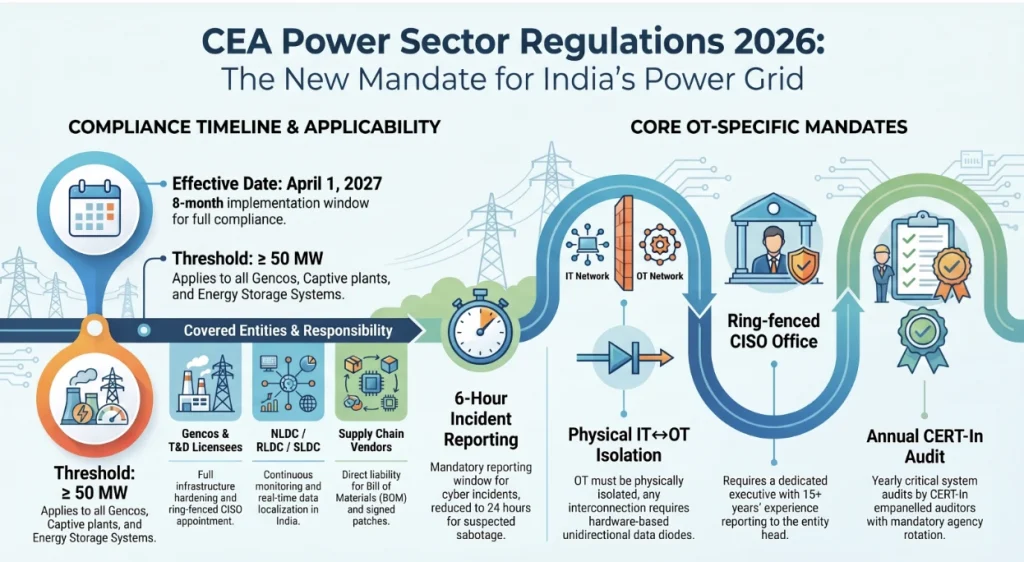
For a long time, plant teams treated Operational Technology (OT) as the quiet sibling of IT—important, but tucked away behind a “wall” of isolation. That wall is coming down. Cyber Security adoption, remote OEM support and increasingly interconnected grids mean OT is no longer a footnote in a power company’s risk register, a utility’s SCADA room, or a process plant’s control room. It is the centre of gravity—and attackers have noticed.
This Is Already Happening
None of this is a workshop scenario. In the last twelve months, OT hijacking has taken real plants and grids offline, and the way attackers got in should worry anyone still relying on a firewall and a password policy:
- Poland, December 2025: attackers forced the steam turbine and water-treatment system at a combined heat and power plant serving roughly 50,000 residents into STOP mode. They got there by compromising a wind farm’s VPN, tunnelling across a private cellular network meant for remote monitoring, and reaching a controller still set to its default password. CERT Polska only disclosed the incident in August 2026, describing it as the first confirmed real-world case of this exact attack path. Residents kept their power and heat only because operators could still run the plant by hand—the automation layer was gone.
- United Kingdom, September 2025: a single intrusion at Jaguar Land Rover forced a precautionary, five-week shutdown of production lines across multiple plants—the company pulled systems offline rather than risk the breach reaching its manufacturing floor. The UK’s Cyber Monitoring Centre called it the most damaging cyberattack in British corporate history, estimating a £1.9 billion hit to the wider economy. In process and discrete manufacturing alike, an IT-only breach is often enough to stop the line.
- India, June 2025: the Ministry of Power confirmed close to 200,000 attempted intrusions on power infrastructure, including direct attempts against SCADA systems, over roughly ten days of heightened tension during “Operation Sindoor.” None succeeded that time. But the volume, and the fact that SCADA itself was the target, is exactly why CEA moved from advisory guidance to binding regulation.
Three different sectors, three different entry points—a wind farm’s remote-access VPN, a corporate IT network, and a barrage of direct probes against SCADA—and in every case the underlying gap was the same: OT that was easier to reach than anyone realised. Closing exactly that gap is what the CEA regulations now require of India’s power, utility and process operators.
The Countdown Has Begun
On 31 July 2026, the CEA (Cyber Security in Power Sector) Regulations, 2026 were officially notified. These aren’t just “best practices” or “suggestions.” They are binding rules under the Electricity Act, 2003 that come into full force on 1 April 2027.
If that date feels far away, consider this: you have exactly eight months to design, build, and evidence compliance. In the world of industrial infrastructure, eight months moves faster than you think.
What Does This Mean for You?
If you are a Genco, a captive plant, or an Energy Storage System (ESS) with a capacity of 50 MW or more, these rules apply to you. They also cover all transmission and distribution (T&D) licensees and power exchanges. The specific numbers here—50 MW, six hours, a ring-fenced CISO—are new, but the underlying expectation is not: OT deserves the same rigour IT has had for two decades. Utilities and process operators watching this space should assume that expectation is coming for them next, CEA-notified or not.
Here is the “Reality Check” on what the law now demands:
- Total Isolation: OT must be physically isolated from the internet and your corporate IT. If a connection is absolutely necessary, it requires board-approved, hardened logical separation.
- No More Simple Firewalls: Regulation 6(3) is clear—IT-OT flows must pass through a unidirectional gateway (a data diode). This is a hardware solution, not just a software rule set.
- A Dedicated CISO: You must appoint a ring-fenced CISO—a senior executive with 15+ years of experience whose only job is cybersecurity.
- The 6-Hour Clock: If an incident occurs, you have just 6 hours to report it to CSIRT-Power and CERT-In (and only 24 hours if it’s an act of sabotage).
- 24/7 Eyes on the Grid: You need a dedicated Information Security Division (ISD) based in India, operating round-the-clock.
The Cost of "Waiting and Seeing"
What happens if April 2027 arrives and you aren’t ready? The repercussions are serious. The Ministry of Power’s CISO has the power to appoint a third-party auditor to come into your business—at your company’s cost. Beyond that, you face legal escalation under the IT Act and Section 142 of the Electricity Act.
How We Can Secure Your Future Together
At Aurionpro, we believe that you cannot pen-test a live power plant, water utility, or process unit like a standard web app. The Poland incident above makes the point better than we can: the plant’s own contractor was initially blamed for what looked like an operational glitch, and it took a specialist review to find the wiper malware underneath. You need tools and people that understand OT protocols and SCADA systems well enough to investigate—and test—without disturbing the process.
As a CERT-In empanelled auditor—the exact qualification required by the new regulations for your mandatory annual audits—we are here to help you bridge the gap. Our team can support you with:
- OT-SOC for ICS and SCADA, plus OT VAPT using safe, passive methods.
- Data diode and unidirectional gateway design through to commissioning.
- CISO-as-a-Service, assisting in the design of your CISO office and 24×7 security division.
My advice? Don’t wait for the deadline to start the conversation.
Let’s begin with a gap assessment to see exactly where your plant stands today. Together, we can ensure your operations are not just compliant, but truly resilient.
References: CERT Polska / CISA advisory AA26-041A, “Poland Energy Sector Cyber Incident Highlights OT and ICS Security Gaps” (August 2026); UK Cyber Monitoring Centre, statement on the Jaguar Land Rover cyber incident (October 2025); Ministry of Power press statement on cyberattacks during Operation Sindoor (June 2025).