

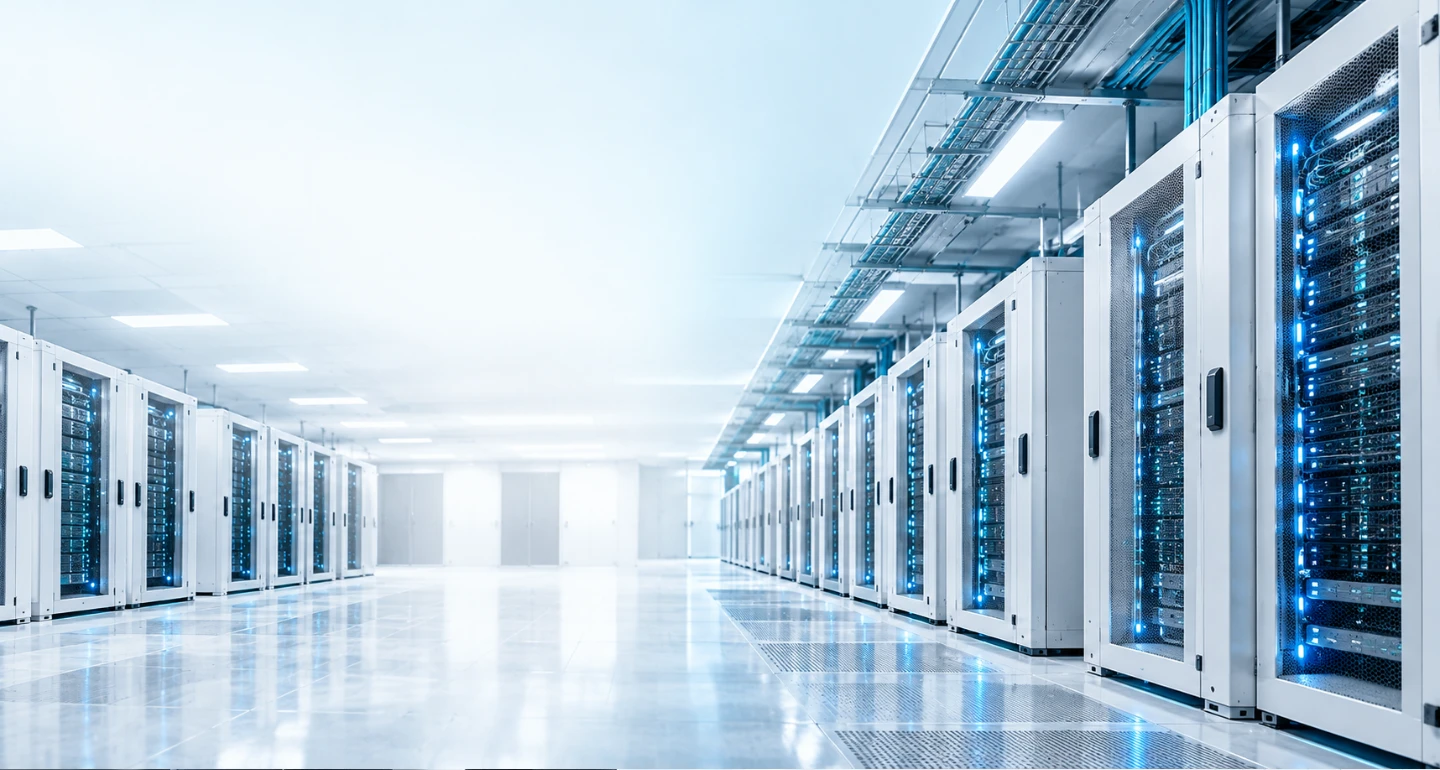
*AI Generated Representative Image*
AI data center design is no longer just about accommodating more computing power. As rack densities move from conventional 10–15 kW configurations towards 100 kW and beyond, the entire facility must be engineered to support higher electrical loads, concentrated heat and new cooling infrastructure.
AI workloads are changing the assumptions behind traditional data center design. GPU-intensive computing concentrates power consumption and heat within a smaller footprint, creating challenges that extend beyond the server rack. The real engineering task is to make the building, electrical systems and cooling architecture work together.
1. Floor loading: The structural challenge
High-density AI racks introduce additional weight through GPU servers, liquid-cooling equipment, coolant distribution units (CDUs), and associated mechanical infrastructure. This changes the structural requirements and potentially the layout of the data hall.
While traditional facilities may be designed around lower equipment loads, AI deployments require structural assessments based on actual rack weights, equipment placement, piping and load distribution. Existing raised floors, slabs, access routes and supporting structures must be evaluated before deployment.
The objective is to ensure that the facility can safely accommodate the intended configuration without costly structural modifications later.
2. Cooling: Beyond conventional air conditioning
Traditional CRAH/CRAC systems and hot- and cold-aisle containment remain effective for many conventional rack densities. However, as AI racks approach 100–120 kW, air cooling alone may become impractical because of the airflow and energy required to remove concentrated heat.
Direct-to-chip liquid cooling (DCLC) transfers heat from processors and other high-power components into a liquid loop. Rear-door heat exchangers (RDHX) offer another approach, removing heat at the rack exhaust. Depending on the equipment, hybrid cooling architectures may combine liquid cooling with room-level air cooling.
The design decision must account for the IT equipment’s thermal requirements, residual heat loads, cooling capacity, maintainability, and future expansion. ASHRAE’s AI data center guidance discusses aligning cooling architecture with rack density.
3. Power distribution: Engineering for higher loads
A rack drawing 100 kW places significantly different demands on electrical infrastructure than one drawing 10 kW. Transformers, switchgear, UPS systems, busways, rack-level distribution and protection systems must be assessed against the intended load, voltage, and redundancy requirements.
Electrical infrastructure therefore needs coordinated design to support safe operation, power quality, reliability and future capacity growth.
4. Secondary Fluid Network: Bringing liquid cooling into the data hall
Liquid cooling also changes what must be installed inside the data center’s white space—the area of housing IT equipment.
A Secondary Fluid Network (SFN) connects CDUs to liquid-cooled racks through supply and return piping, manifolds, valves and associated controls. The CDU transfers heat between the facility-side cooling loop and the secondary loop while managing coolant circulation and operating conditions.
This introduces new design considerations, including pipe routing, pressure and flow management, leak detection, maintenance access, and integration with the wider cooling system.
The SFN must be planned alongside rack layouts, electrical distribution, and mechanical infrastructure, rather than treated as an isolated addition.
Designing the data center as one integrated system
The transition from 10 kW to 120 kW per rack is ultimately a facility-wide engineering challenge. Structural capacity, power distribution, thermal management, and fluid networks are interdependent on design decisions.
For data center developers and operators, evaluating these systems together from the outset can help identify constraints before they become expensive retrofit challenges.
AI-ready infrastructure is not defined by rack density alone. It depends on how effectively the entire facility is engineered to support the computing workloads it is built for.