

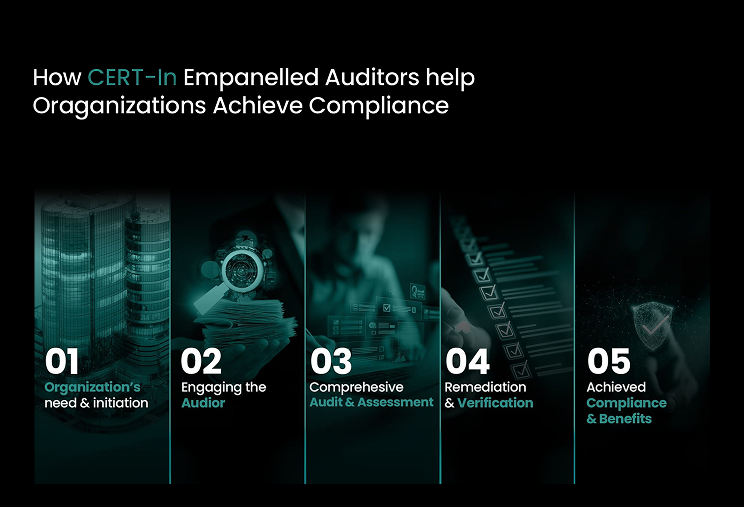
CERT-In empanelled auditors act as the primary validation authority for organizations operating in India’s regulated sectors. Their role goes beyond technical testing; they serve as a government-authorized checkpoint to ensure entities meet specific statutory and industry mandates.
Here is how they help organizations achieve compliance:
1. Fulfilling Mandatory Regulatory Requirements
For many sectors, a security audit by a CERT-In empanelled auditor is not optional but a legal requirement. These auditors provide the necessary certification to satisfy various regulators:
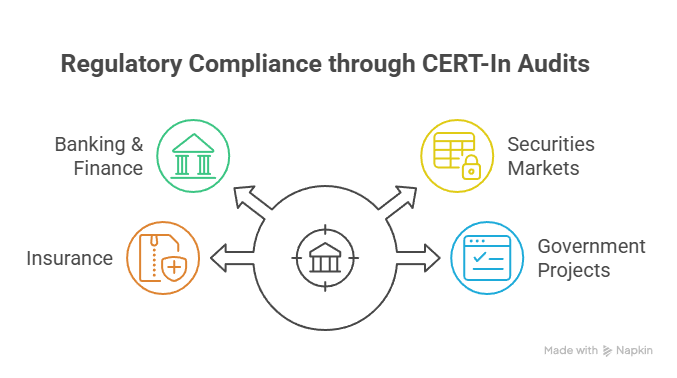
• Banking & Finance (RBI): The Reserve Bank of India (RBI) mandates that scheduled commercial banks, NBFCs, and payment system operators undergo annual security audits. Empanelled auditors validate compliance with RBI’s cybersecurity frameworks for banks and digital payment security controls.
• Securities Markets (SEBI): Stockbrokers, depositories, and mutual funds must submit VAPT reports and cyber resilience audit reports to SEBI. These audits verify compliance with SEBI’s Cybersecurity and Cyber Resilience Framework (CSCRF) and must be conducted by empanelled auditors to be accepted.
• Insurance (IRDAI): Insurance companies must undergo periodic security audits to ensure the safety of policyholder data and digital platforms in line with IRDAI guidelines.
• Government Projects (NIC): Any application or website hosted on the National Informatics Centre (NIC) infrastructure requires a “Safe-to-Host” certificate. Only CERT-In empanelled auditors are authorized to issue this certificate after rigorous testing and vulnerability remediation.
2. Validating Compliance with National Laws
• IT Act, 2000 & 2008: Under Section 43A and Section 70B, organizations must implement “reasonable security practices.” Empanelled auditors verify these controls, helping organizations demonstrate due diligence which is crucial for avoiding penalties in the event of a breach.
• DPDP Act, 2023: With the new data protection law, “Significant Data Fiduciaries” (SDFs) are required to undergo periodic independent data audits. Empanelled auditors are positioned to assess technical safeguards like encryption and access controls mandated by the Act to protect personal data.
3. Delivering “Regulator-Ready” Reports
Regulators often reject audit reports that do not follow specific formats or evidence-handling procedures. Empanelled auditors ensure compliance by:
• Standardized Reporting: They produce reports structured to meet the specific documentation requirements of bodies like SEBI and RBI, reducing the risk of rejection or queries during inspections.
• Evidence Handling: They follow strict chain-of-custody procedures for audit evidence, ensuring that findings are legally defensible during regulatory investigations.
• Securities Markets (SEBI): Stockbrokers, depositories, and mutual funds must submit VAPT reports and cyber resilience audit reports to SEBI. These audits verify compliance with SEBI’s Cybersecurity and Cyber Resilience Framework (CSCRF) and must be conducted by empanelled auditors to be accepted.
• Insurance (IRDAI): Insurance companies must undergo periodic security audits to ensure the safety of policyholder data and digital platforms in line with IRDAI guidelines.
• Government Projects (NIC): Any application or website hosted on the National Informatics Centre (NIC) infrastructure requires a “Safe-to-Host” certificate. Only CERT-In empanelled auditors are authorized to issue this certificate after rigorous testing and vulnerability remediation.
4. Lifecycle Management: From Detection to Closure
Compliance is not just about finding flaws but fixing them. Empanelled auditors guide organizations through the full compliance lifecycle:
• VAPT & Gap Analysis: They conduct Vulnerability Assessment and Penetration Testing (VAPT) to identify gaps against standards like OWASP, NIST, and ISO 27001.
• Remediation Support: They provide technical guidance to IT teams on how to patch identified vulnerabilities.
• Re-Testing (Validation): Crucially, they conduct re-tests to verify that fixes work. A final compliance certificate is issued only after high-severity issues are closed, ensuring the organization is genuinely secure before declaring compliance.
5. Managing Vendor and Supply Chain Risk
Under new guidelines (such as the 2025 mandates), organizations are responsible for the security of their third-party vendors. Empanelled auditors help organizations audit their supply chain partners to ensure they meet the required security standards, a critical step for sectors like banking where outsourcing is common.
Conclusion:
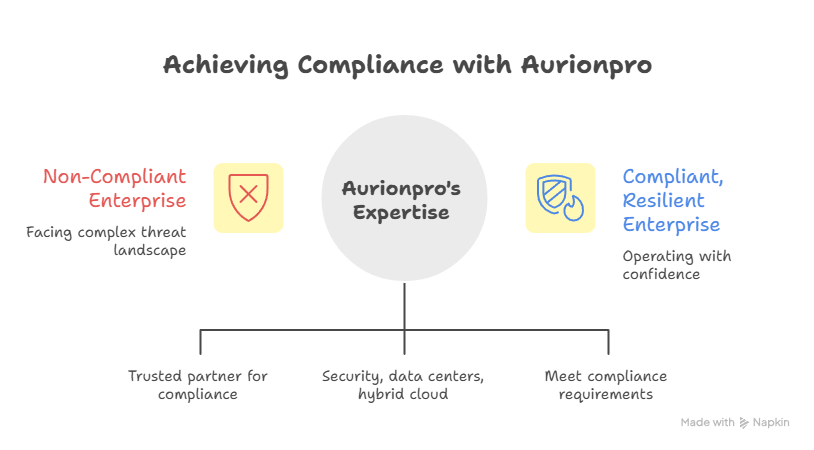
Aurionpro is proud to be CERT-In empanelled, reinforcing its position as a trusted partner in helping enterprises become compliant, resilient, and future-ready. With deep expertise across security, data centers, and hybrid cloud, Aurionpro enables organizations not just to meet regulatory mandates, but to operate with confidence in an increasingly complex threat landscape.
For more information or to explore how we can support your compliance journey, please reach out to us at info@aurionpro.com.
Written by – Mr. Jigger Shah, Senior Vice President, Enterprise Business, Hybrid Cloud Services, Aurionpro Solutions Limited.