

What it takes to build category-leading lending software
- Lending
- Exclusive Aurionpro leadership interview
Aurionpro’s two presidents on what sits behind the Integro Lending Suite’s Chartis Category Leader recognition: a re-engineered, persona-based platform, AI used in production rather than in slideware, and the regulation heading for lending next.
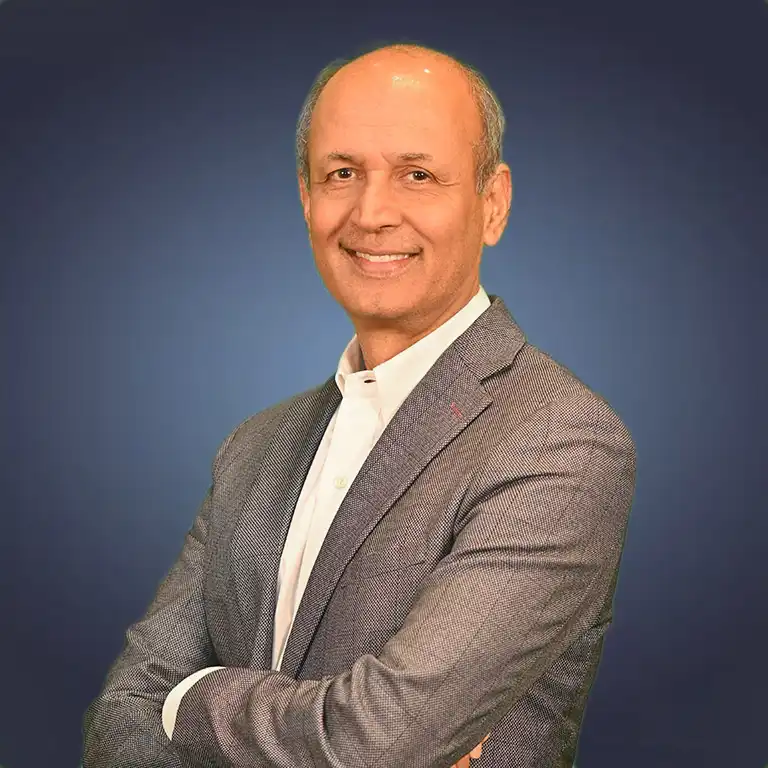
Shekhar Mullatti
President, Banking Solutions Group

Sanjay Varma
President, Fintech Solutions Group

Sachin Salian
Host, CMO
Watch in parts
Each part stands alone and has its own link.
The short version
Aurionpro’s Integro Lending Suite has been named a Chartis Category Leader. In this conversation, Shekhar Mullatti and Sanjay Varma explain what sits behind it: a platform re-engineered around APIs, microservices and personas rather than one monolithic product, AI applied in small production steps, and an approach that starts with the bank’s business problem and only then reaches for technology.
The relaunch wasn’t just branding. The suite was re-engineered for an inflection point in which lending platforms become analytic, decision-led and organised around business objectives rather than the database.
2:21
Products are now persona-based rather than monolithic: a dealer originating an asset, a broker originating a home loan, a relationship manager originating an SME loan.
07:10
Lending’s problems haven’t changed: time to yes, a unified customer and credit view, and complexity bred by technical debt.
12:57
Intuitive simplicity in practice: one captive finance deployment went from nine screens and about 80 fields to a single screen with 20 to 25, doing the same job.
15:19
On the corporate side, a delta view of a re-submitted credit dossier cut approval timelines from three weeks to three days, and from three months to three weeks.
19:43
AI is being used in small, production-ready steps: assisted journeys, document validation instead of document collection, and simplified decisions for the underwriter.
24:47
Two regulatory waves are coming: AI explainability, and oversight of private credit.
30:53
In this episode
Full transcript
-
0:00
Why the Chartis recognition matters -
2:01
Why Integro was rebranded and re-engineered -
4:04
Integro and the future of digital credit -
5:59
Business problems first, technology second -
8:34
Retail: an API-first, persona-based rebuild -
9:41
Corporate: structuring complex credit elegantly -
12:27
The three problems lending has never solved -
16:04
Intuitive simplicity: redesigning UI and UX -
18:15
Corporate impact: reading only what changed -
20:38
The technology under the suite -
21:55
Arya.ai, and where AI actually gets used -
27:07
What makes a banker adopt AI -
29:57
What’s coming: AI explainability and private credit -
33:34
ESG, private credit and who eats whose lunch -
35:52
Where Integro goes next, and closing
0:00 | Why the Chartis recognition matters
0:09
Sachin Salian
Hi, my name is Sachin Salian. I’m the Chief Marketing Officer of Aurionpro. Welcome to the very first episode of Aurionpro Dialogues with Leadership.
0:22
Sachin Salian
Today we’re talking about Aurionpro’s Integro Lending Suite, which has just been ranked a Category Leader in the Chartis quadrants. Here to speak with us are two Aurionpro presidents, Shekhar Mullatti and Sanjay Varma. Welcome.
0:42
Sachin Salian
I’ll start with the obvious question. The Integro Lending Suite has been recognised by Chartis three years running. That’s a powerful endorsement. What does it mean for the platform and for your customers globally? Sanjay?
0:59
Sanjay Varma
The biggest thing is that it endorses that we’re doing the right things. We’re addressing the key business issues a lending solution has to address, and doing it well. It’s a validation, from Chartis and from our customers, that we’re on the right track and leading ahead.
1:29
Shekhar Mullatti
To add to what Sanjay is saying, this is validation at the global level. Chartis maps our capabilities and expertise across a cross-section of customers who are large, leading global banks. That’s precisely the segment we’re after.
2:01 | Why Integro was rebranded and re-engineered
2:01
Sachin Salian
Give us some insight into the vision behind the Integro Lending Suite. It has just been launched. Why now? Why rebrand and relaunch?
2:21
Sanjay Varma
It isn’t just a rebrand. We’ve technically re-engineered and revamped a lot of the products inside the suite. There are two reasons. First, there’s an inflection point in technology and financial services right now. It’s a cliché to say it’s led by AI, but whatever the reason, that inflection point will roll out over the next year or two.
2:52
Sanjay Varma
Every lending software platform will become more analytical and decision-led, with more guided journeys, more independent micro-services, and software that is organized around business objectives rather than being a representation of what sits in the database.
3:15
Sanjay Varma
We’ve been focused on future-proofing ourselves for that journey, and with companies like Arya helping us stay business-first, micro-services-based and API-enabled, we’ve taken the steps to be ahead of the curve. When you’re doing that and an inflection point arrives, you rebrand and relaunch so that the world, and more importantly the banks who will use us, recognize what we’re doing.
4:04 | Integro and the future of digital credit
4:04
Sachin Salian
Shekhar, how does the Integro Lending Suite align with the future of digital credit?
4:15
Shekhar Mullatti
Credit of all kinds will keep playing a leading role in commerce worldwide. As world GDP grows, lending has to grow. Our ambition at Aurionpro is to be a global leader in this space in software.
4:41
Shekhar Mullatti
To do that we’ve done a couple of things. First, we occupy all the points on the value chain, so we can address every customer with a solution that solves their business problems.
4:57
Shekhar Mullatti
Second, we’re not just technology. We’re lending experts first, and we use technology to enable that lending expertise. That lets us have a real dialogue with customers about their business problems, brainstorm together and shape what credit looks like for them.
5:26
Shekhar Mullatti
The reality is that the future will look a little different for customers in different parts of the world. What we need to be is adaptable, flexible and agile enough to match those differences across regions and across sectors. That’s where we are.
5:59 | Business problems first, technology second
5:59
Sachin Salian
Let’s peel the onion. In an increasingly crowded space, how does Integro stand apart?
6:18
Sanjay Varma
Start with what we aim to do differently. Our approach has always been business problems first. As Shekhar said, work out how best to address the business problem, then use technology to enable it, rather than the other way round, where a technology solution happens to cover some business aspects.
6:48
Sanjay Varma
Three things follow. First, our view is driven by our customers: their problems, how they want to differentiate. Most of our product roadmaps are domain-specific and domain-differentiated, so technology follows rather than leads.
7:10
Sanjay Varma
Second, we’ve moved away from a single monolithic product to persona-based journeys. That makes what we take to a client specific to their business needs instead of a broad stroke across the lending spectrum, and it makes the product highly configurable and adaptable to a particular region, lending type or community.
7:46
Sanjay Varma
Third, we’re infusing a lot of intelligence and analytics into the products to stay ahead of the curve. So: business first and technology next, persona-based rather than thick products, and intelligence built in.
8:34 | Retail: an API-first, persona-based rebuild
8:34
Sachin Salian
On retail lending, what IP are you investing in, and what features are you planning?
8:46
Sanjay Varma
The key thing we’ve done is re-architect and refresh the entire product around an API-first, microservices-enabled, persona-based stack. We’ve moved from saying ours is, say, a loan origination product, to saying it’s an origination product that caters to specific personas.
9:08
Sanjay Varma
A dealer originating an asset. A broker originating a home loan. A relationship manager originating an SME loan. We’ve put all the necessary components behind each one, and that differentiates us in the market. We’d be among the first few to re-architect in this direction and build in the AI components.
9:41 | Corporate: structuring complex credit elegantly
9:41
Sachin Salian
Shekhar, what makes Integro stand apart on the corporate side?
9:47
Shekhar Mullatti
When we design our products and services we always keep in mind the top five to ten banks in a country. These banks are big. They have large corporates as customers, and those customers have very complex financing needs.
10:09
Shekhar Mullatti
To structure that elegantly you need a very good data structure: the customer group on one side, the facility details on another, and collateral as the third pillar. Then you loop end to end through the permutations and combinations to deliver what’s called a one-obligor exposure.
10:32
Shekhar Mullatti
It sounds simple, but it isn’t simple to do, and we execute it very elegantly. That’s one example of why our customers love using our system. It helps them serve their customers better and more transparently, and faster than would otherwise have happened.
10:57
Sachin Salian
How does that translate into solving actual problems for banks?
11:05
Shekhar Mullatti
When a customer comes for credit, the bank wants to identify the bankable customers and give them that credit as quickly and conveniently as possible. That’s what our system helps them do.
11:28
Shekhar Mullatti
Second, if they feel a customer isn’t creditworthy, they need the system to flag the areas that are borderline and need incremental due diligence, and to do that in a sophisticated way, because the customers are sophisticated.
11:53
Shekhar Mullatti
Third, the application flow is collaborative. There are credit committees, so our platform lets people communicate with each other before arriving at a credit decision. All of this enables the bank to serve the customer better: they get the customer they want, the credit they want, and the return they’re looking for.
12:27 | The three problems lending has never solved
12:27
Sachin Salian
Sanjay, on the retail side the life cycle is different. What problems are you solving?
12:35
Sanjay Varma
Here’s the funny thing. The problems in the lending ecosystem, whether in asset finance, retail or SME, aren’t new. They’re the same problems in a different shape, and they come down to two or three things.
12:57
Sanjay Varma
Time to yes. That’s the biggest one. How quickly can I give a decision? It’s an age-old problem.
13:05
Sanjay Varma
Then a unified customer and credit view. Can I get every piece of information, every document, every fact or analysis about the customer in a single place? You’d think these are basic problems to solve, and yet they’re big challenges today, partly because of the technical debt built up over the years, and partly because of bank infrastructure where data sits all over the place and isn’t shared.
13:48
Sanjay Varma
The third is complexity from technical debt. You start with a very simple, nice-looking system, and over a few years it ends up a mass of input fields everywhere. These three problems are exactly what we’ve set out to address.
14:10
Sanjay Varma
One of the big things we’ve done is work out how to bring all the information together, so a unified credit and customer view is at the root of everything. With today’s technology, with open banking and APIs, that’s possible in a way it wasn’t five or six years ago.
14:31
Sanjay Varma
Because we refreshed our technology, we don’t carry that debt, and we can adopt changes faster. That feeds into time to yes, where we use every business and technical advantage we can get.
14:59
Sanjay Varma
And then there’s a phrase you’ll hear a lot at Aurionpro: intuitive simplicity. How do I make something simple, yet intuitive, that still does the job?
15:19
Sanjay Varma
An example. We were deploying one of our systems for a captive finance company, one of the larger ones doing commercial vehicle finance globally, in the US. What they were using had about nine screens with close to 70 or 80 fields. We simplified it to a single screen with around 20 to 25 fields, and it did the same job. It’s a question of going back to basics and doing them better.
16:04 | Intuitive simplicity: redesigning UI and UX
16:04
Sachin Salian
Can you double down on intuitive simplicity? We’ve heard a lot of feedback on this.
16:16
Sanjay Varma
We redesigned our entire UI and UX. They’re two separate things. People use the terms interchangeably, but user interface and user experience are distinct components of design.
16:40
Sanjay Varma
We looked at what it takes to complete a process, whether that’s data entry of a client’s personal information, credit information or income and expenses, and asked what the simplest, neatest way to do it is without adding complexity.
17:07
Sanjay Varma
Once you can control that and take it through a logical flow that’s business-driven rather than technology-driven, you start asking why anything more than what you already have is needed. What value will it add? Does that value trade off well against the technical debt and overhead it adds?
17:27
Sanjay Varma
We’ve been strict and diligent about it. We’ve pushed back on clients, asking them to tell us why what we’re doing won’t work for them, and more often than not they agree that it will. It’s about changing how you approach the problem, and understanding one basic tenet of human thought: people like looking at neat, clean, beautiful things. Provide that in software and you’ll get acceptance, just as in real life.
18:15 | Corporate impact: reading only what changed
18:15
Sachin Salian
Shekhar, on the corporate side, give us some of the real impact stories. Integro has been around for years and has marquee customers.
18:47
Shekhar Mullatti
There are several, but one that comes to mind is a feature we call Show Diff.
18:57
Shekhar Mullatti
In a corporate loan process the relationship manager prepares a fairly thick dossier about the customer and the facility and gives it to the credit approver. The approver studies it in depth and is quite likely to come back with ten or fifteen questions. The RM takes those questions back to the customer, the answers are collated, and it all comes back to the credit approver.
19:43
Shekhar Mullatti
Before our system, the approver would read that hundred-page dossier front to back all over again. Now there’s an elegant mechanism where they only read the deltas, and those deltas are granular, at the field level. That cuts the rework right down. For us, that’s injecting simplicity into the process and delivering successful outcomes.
20:18
Shekhar Mullatti
This alone helped some of our customers cut timelines from three weeks to three days, and from three months to three weeks.
20:38 | The technology under the suite
20:38
Sachin Salian
That’s powerful impact. What kind of enterprise technology and IP powers those outcomes?
20:59
Shekhar Mullatti
The underlying technology elements are very similar throughout the lending suite: microservices, API-first, and from there we’re moving to an AI-native architecture, ready for now and for what comes after.
21:22
Shekhar Mullatti
What differs is how those are adapted to each business segment. The underlying layer is the same, and the technology skills we’re accumulating across the company are similar too. Increasingly the differentiation will be in the domain, in the customer subject area.
21:55 | Arya.ai, and where AI actually gets used
21:55
Sachin Salian
There’s a meme going around: the CEO says AI, the business head says AI, the technology team says AI. How do you rise above that noise? Help us understand how last year’s acquisition of Arya.ai, a team of data scientists who’ve been at this for more than a decade, turns into practical applications inside the Integro suite.
22:35
Sanjay Varma
It would be wrong to talk about technology innovation and not talk about AI, clichéd as that may sound. I’ve been lucky enough to witness two inflection moments in technology. The first was when three-tier architecture arrived and we browser-enabled our applications. Everybody was talking about web browsers. It’s the same now with AI.
23:16
Sanjay Varma
Over the next couple of years AI will become central to almost everything we do, but not in the way it’s shown in the movies, with Terminator and Skynet. More in the way the web browser changed our lives. It will be a powerful tool that lets us leapfrog, doing tasks, analysis and assistance that are quasi-human.
23:47
Sanjay Varma
Will it replace human beings? Not in the near future. It will guide and assist them, the same way the web browser did. It didn’t replace people, it expanded technology’s reach.
24:15
Sanjay Varma
As our CEO Ashish likes to say, you’ll find a million people with one year of AI experience, but only a handful with more than ten. Arya is a bunch of such people. They know what it takes to AI-enable an application, and they know the difference between taking an application to a prototype and taking a prototype into production. We’re leveraging that advantage and taking baby steps.
24:47
Sanjay Varma
First, assisted journeys. Time to yes is the big thing we’re trying to solve, so can AI assist in making, or at least guiding, decisions that would otherwise stop the application flow?
25:13
Sanjay Varma
We’re also using AI for document processing, and this one is interesting. Document collection is the cornerstone of every loan origination process. Every time you apply for a loan the first thing you’re asked for is this document and that document, and most origination systems have a very complex flow for collecting them.
25:40
Sanjay Varma
But go back to the heart of it and ask: do you really need the documents? What do you need them for? You need them to validate that the person is who they say they are and that what they’re claiming is true. You don’t need the document, you need the validation. That’s where AI can be used smartly: look at whatever sources are available and validate the claim, rather than collecting another document.
26:24
Sanjay Varma
So, to recap, we’re using it in small steps around assisted journeys, time to yes, unified credit and unified customer information, and to do away with things that have become necessary but are actually redundant. The biggest one will be simplifying complex decisions, so what’s presented to a credit underwriter or relationship manager is a simple view: I looked at this application, this portfolio, this person, everything looks fine, you just need to check this one thing.
27:07 | What makes a banker adopt AI
27:07
Sachin Salian
Shekhar, you’re an ex-banker, at Bank of America I believe. Put your banker’s hat on. What makes a banker want to adopt this kind of technology? What goes through their mind?
27:34
Shekhar Mullatti
A banker really doesn’t want a lot of hassle. Banking is a heavily regulated industry. Some documentation is there to provide information; some of it is mandated by compliance, and you have to store it for several years afterwards.
28:01
Shekhar Mullatti
So if some technology can eliminate the hassle of collating information and analysing what’s in those documents, while still maintaining an audit trail, that’s a great way to reduce the burden. On the corporate side the banker wants to strike a deal with the customer and say: this is a great investment you’re making, and we want to finance and structure it.
28:42
Shekhar Mullatti
That’s exactly how we’re trying to leverage technology. For us it’s a natural evolution, because what comes intuitively to us is solving the customer’s business problem and using technology to do it. AI is the new technology that we think will accelerate most of what we already do.
29:06
Shekhar Mullatti
Take financial documents. For a corporate, those have to be analysed, and there’s so much content in them. They have to be crunched into a rating or a scoring model, because that’s how credit is assessed. If AI can take the grunt work out of that, it’s a win.
29:30
Shekhar Mullatti
Today our relationship managers write long, detailed summaries of their applications, which are read out in credit committees. If AI can help them generate those at an acceptable level of accuracy, that’s a great way the technology really helps.
29:57 | What’s coming: AI explainability and private credit
29:57
Sachin Salian
Let’s move to the last segment, and I’d like both of you on this. You’ve both been around the industry for decades, on the banking side and the technology side. What are the big trends in lending today? Sanjay?
30:22
Sanjay Varma
Everybody is speaking about AI to death. What we also need to understand is that it has been a while since a new set of regulations came through. I think there’s an upcoming wave of regulation that will hit lending in two areas.
30:53
Sanjay Varma
The first is the regulation of AI explainability. That’s going to be a big one. As people start productionising AI-based tools, there will be a need for explainability. Europe has already started on AI regulation, and it’s a matter of time before others follow.
31:27
Sanjay Varma
It will be big not only because everyone is asking about it, but because for a long time people genuinely won’t know what needs to be done. A regulator might say: you took a decision based on what the AI model gave you, so tell me how it arrived at that. The whole idea of using AI was that you wouldn’t have to work that out. So a lot of explainability and back-tracing will have to come in.
32:12
Sanjay Varma
The second area, surprisingly, is one we’re pursuing diligently because we think it’s a growth sector: private financiers and private credit. It’s largely unregulated right now, and it’s a matter of time before it comes to regulators’ attention. What started as filling a gap for SMEs and businesses the banks couldn’t serve has grown into an almost independent segment.
32:47
Sanjay Varma
Beyond regulation, I think we’ll see a tighter binding of finance to purchase. We saw it with buy now, pay later, but that was just a start, aimed at an underserved and more subprime segment. The separation between purchase and funding is going away; it’s just a matter of time.
33:20
Sanjay Varma
That could be a very big trend, especially when you link it to the digitalisation of currencies. How do you measure risk on it, how do you control it? And things stop being looked at as a price tag and start being looked at as a monthly payment.
33:34 | ESG, private credit and who eats whose lunch
33:34
Shekhar Mullatti
Likewise, on the corporate side: explainability regulation, of course, but another interesting area is ESG. With the Trump administration everybody thinks it’s going to disappear. When we talk to our customers it’s quite the contrary.
34:14
Shekhar Mullatti
Leading banks in most countries have been around for decades, some for half a century. They know a politician comes and goes in four years, but the business is here to stay. So they’re continuing to invest in ESG capabilities. There’s a fundamental belief that it’s a good thing. How much the regulatory screw is tightened or loosened may vary, but the capability needs to be there.
34:59
Shekhar Mullatti
Private credit, on the corporate side, with the BlackRocks of the world, is becoming a monster. Like most financial trends it’s very US-centric at the moment, but there’s enough liquidity in the world that others will follow.
35:31
Shekhar Mullatti
If you talk to retail bankers and ask what keeps them awake at night, they say fintechs are going to eat their lunch. If you talk to corporate bankers, they say private credit is going to eat their lunch. We listen, and we say we should be there regardless of who eats whose lunch. Our solution has to cater to all those segments.
35:52 | Where Integro goes next, and closing
35:52
Sachin Salian
That’s a good segue to my last question. Where does Integro go next, geographically and by segment?
36:17
Sanjay Varma
It’s a two-pronged approach. We’ll consolidate and refresh our current client base and home markets. For this coming year our focus is Europe, and within Europe specific zones: DACH and the UK.
36:48
Sanjay Varma
The third focus, which is almost a separate segment in itself, is captive finance: captive asset finance, captive equipment finance, brand-led financing. So: captives, expanding into those two specific European markets, and helping our current install base adopt the technology refresh we’ve done.
37:14
Shekhar Mullatti
Europe is bang on, and the flavour of Europe lends itself very well to our product’s capabilities. Europe is multi-currency, multi-language, multi-country, and we do that routinely. We can even share some best practices on how to operate effectively in that environment.
37:41
Shekhar Mullatti
Many of these banks don’t know such a seamless platform is available. We’re keen to get out there, hold some dialogues, showcase our capabilities, understand their business problems, adapt our models to the European way of doing business and arrive at a win-win.
38:09
Sachin Salian
Thank you both for your time. It’s been a wonderful discussion. What we’re seeing in Integro isn’t just the expansion plans; it’s the depth of domain and capability, with the intelligence we bring from the Arya group and the IP we build.
38:30
Sachin Salian
We’ll sign off there. Thank you for watching the first in our series. If you’d like an in-depth conversation on either the corporate or the retail side of lending, reach out to us at aurionpro.com. We’d be glad to get in touch.
0:09
Sachin Salian
Hi, my name is Sachin Salian. I’m the Chief Marketing Officer of Aurionpro. Welcome to the very first episode of Aurionpro Dialogues with Leadership.
0:22
Sachin Salian
Today we’re talking about Aurionpro’s Integro Lending Suite, which has just been ranked a Category Leader in the Chartis quadrants. Here to speak with us are two Aurionpro presidents, Shekhar Mullatti and Sanjay Varma. Welcome.
0:42
Sachin Salian
I’ll start with the obvious question. The Integro Lending Suite has been recognised by Chartis three years running. That’s a powerful endorsement. What does it mean for the platform and for your customers globally? Sanjay?
0:59
Sanjay Varma
The biggest thing is that it endorses that we’re doing the right things. We’re addressing the key business issues a lending solution has to address, and doing it well. It’s a validation, from Chartis and from our customers, that we’re on the right track and leading ahead.
1:29
Shekhar Mullatti
To add to what Sanjay is saying, this is validation at the global level. Chartis maps our capabilities and expertise across a cross-section of customers who are large, leading global banks. That’s precisely the segment we’re after.
2:01
Sachin Salian
Give us some insight into the vision behind the Integro Lending Suite. It has just been launched. Why now? Why rebrand and relaunch?
2:21
Sanjay Varma
It isn’t just a rebrand. We’ve technically re-engineered and revamped a lot of the products inside the suite. There are two reasons. First, there’s an inflection point in technology and financial services right now. It’s a cliché to say it’s led by AI, but whatever the reason, that inflection point will roll out over the next year or two.
2:52
Sanjay Varma
Every lending software platform will become more analytical and decision-led, with more guided journeys, more independent microservices, and software that is organised around business objectives rather than being a representation of what sits in the database.
3:15
Sanjay Varma
We’ve been focused on future-proofing ourselves for that journey, and with companies like Arya helping us stay business-first, microservices-based and API-enabled, we’ve taken the steps to be ahead of the curve. When you’re doing that and an inflection point arrives, you rebrand and relaunch so that the world, and more importantly the banks who will use us, recognise what we’re doing.
5:59
Sachin Salian
Let’s peel the onion. In an increasingly crowded space, how does Integro stand apart?
6:18
Sanjay Varma
Start with what we aim to do differently. Our approach has always been business problems first. As Shekhar said, work out how best to address the business problem, then use technology to enable it, rather than the other way round, where a technology solution happens to cover some business aspects.
6:48
Sanjay Varma
Three things follow. First, our view is driven by our customers: their problems, how they want to differentiate. Most of our product roadmaps are domain-specific and domain-differentiated, so technology follows rather than leads.
7:10
Sanjay Varma
Second, we’ve moved away from a single monolithic product to persona-based journeys. That makes what we take to a client specific to their business needs instead of a broad stroke across the lending spectrum, and it makes the product highly configurable and adaptable to a particular region, lending type or community.
7:46
Sanjay Varma
Third, we’re infusing a lot of intelligence and analytics into the products to stay ahead of the curve. So: business first and technology next, persona-based rather than thick products, and intelligence built in.
8:34
Sachin Salian
On retail lending, what IP are you investing in, and what features are you planning?
8:46
Sanjay Varma
The key thing we’ve done is re-architect and refresh the entire product around an API-first, microservices-enabled, persona-based stack. We’ve moved from saying ours is, say, a loan origination product, to saying it’s an origination product that caters to specific personas.
9:08
Sanjay Varma
A dealer originating an asset. A broker originating a home loan. A relationship manager originating an SME loan. We’ve put all the necessary components behind each one, and that differentiates us in the market. We’d be among the first few to re-architect in this direction and build in the AI components.
9:41
Sachin Salian
Shekhar, what makes Integro stand apart on the corporate side?
9:47
Shekhar Mullatti
When we design our products and services we always keep in mind the top five to ten banks in a country. These banks are big. They have large corporates as customers, and those customers have very complex financing needs.
10:09
Shekhar Mullatti
To structure that elegantly you need a very good data structure: the customer group on one side, the facility details on another, and collateral as the third pillar. Then you loop end to end through the permutations and combinations to deliver what’s called a one-obligor exposure.
10:32
Shekhar Mullatti
It sounds simple, but it isn’t simple to do, and we execute it very elegantly. That’s one example of why our customers love using our system. It helps them serve their customers better and more transparently, and faster than would otherwise have happened.
10:57
Sachin Salian
How does that translate into solving actual problems for banks?
11:05
Shekhar Mullatti
When a customer comes for credit, the bank wants to identify the bankable customers and give them that credit as quickly and conveniently as possible. That’s what our system helps them do.
11:28
Shekhar Mullatti
Second, if they feel a customer isn’t creditworthy, they need the system to flag the areas that are borderline and need incremental due diligence, and to do that in a sophisticated way, because the customers are sophisticated.
11:53
Shekhar Mullatti
Third, the application flow is collaborative. There are credit committees, so our platform lets people communicate with each other before arriving at a credit decision. All of this enables the bank to serve the customer better: they get the customer they want, the credit they want, and the return they’re looking for.
12:27
Sachin Salian
Sanjay, on the retail side the life cycle is different. What problems are you solving?
12:35
Sanjay Varma
Here’s the funny thing. The problems in the lending ecosystem, whether in asset finance, retail or SME, aren’t new. They’re the same problems in a different shape, and they come down to two or three things.
12:57
Sanjay Varma
Time to yes. That’s the biggest one. How quickly can I give a decision? It’s an age-old problem.
13:05
Sanjay Varma
Then a unified customer and credit view. Can I get every piece of information, every document, every fact or analysis about the customer in a single place? You’d think these are basic problems to solve, and yet they’re big challenges today, partly because of the technical debt built up over the years, and partly because of bank infrastructure where data sits all over the place and isn’t shared.
13:48
Sanjay Varma
The third is complexity from technical debt. You start with a very simple, nice-looking system, and over a few years it ends up a mass of input fields everywhere. These three problems are exactly what we’ve set out to address.
14:10
Sanjay Varma
One of the big things we’ve done is work out how to bring all the information together, so a unified credit and customer view is at the root of everything. With today’s technology, with open banking and APIs, that’s possible in a way it wasn’t five or six years ago.
14:31
Sanjay Varma
Because we refreshed our technology, we don’t carry that debt, and we can adopt changes faster. That feeds into time to yes, where we use every business and technical advantage we can get.
14:59
Sanjay Varma
And then there’s a phrase you’ll hear a lot at Aurionpro: intuitive simplicity. How do I make something simple, yet intuitive, that still does the job?
15:19
Sanjay Varma
An example. We were deploying one of our systems for a captive finance company, one of the larger ones doing commercial vehicle finance globally, in the US. What they were using had about nine screens with close to 70 or 80 fields. We simplified it to a single screen with around 20 to 25 fields, and it did the same job. It’s a question of going back to basics and doing them better.
16:04
Sachin Salian
Can you double down on intuitive simplicity? We’ve heard a lot of feedback on this.
16:16
Sanjay Varma
We redesigned our entire UI and UX. They’re two separate things. People use the terms interchangeably, but user interface and user experience are distinct components of design.
16:40
Sanjay Varma
We looked at what it takes to complete a process, whether that’s data entry of a client’s personal information, credit information or income and expenses, and asked what the simplest, neatest way to do it is without adding complexity.
17:07
Sanjay Varma
Once you can control that and take it through a logical flow that’s business-driven rather than technology-driven, you start asking why anything more than what you already have is needed. What value will it add? Does that value trade off well against the technical debt and overhead it adds?
17:27
Sanjay Varma
We’ve been strict and diligent about it. We’ve pushed back on clients, asking them to tell us why what we’re doing won’t work for them, and more often than not they agree that it will. It’s about changing how you approach the problem, and understanding one basic tenet of human thought: people like looking at neat, clean, beautiful things. Provide that in software and you’ll get acceptance, just as in real life.
18:15
Sachin Salian
Shekhar, on the corporate side, give us some of the real impact stories. Integro has been around for years and has marquee customers.
18:47
Shekhar Mullatti
There are several, but one that comes to mind is a feature we call Show Diff.
18:57
Shekhar Mullatti
In a corporate loan process the relationship manager prepares a fairly thick dossier about the customer and the facility and gives it to the credit approver. The approver studies it in depth and is quite likely to come back with ten or fifteen questions. The RM takes those questions back to the customer, the answers are collated, and it all comes back to the credit approver.
19:43
Shekhar Mullatti
Before our system, the approver would read that hundred-page dossier front to back all over again. Now there’s an elegant mechanism where they only read the deltas, and those deltas are granular, at the field level. That cuts the rework right down. For us, that’s injecting simplicity into the process and delivering successful outcomes.
20:18
Shekhar Mullatti
This alone helped some of our customers cut timelines from three weeks to three days, and from three months to three weeks.
20:38
Sachin Salian
That’s powerful impact. What kind of enterprise technology and IP powers those outcomes?
20:59
Shekhar Mullatti
The underlying technology elements are very similar throughout the lending suite: microservices, API-first, and from there we’re moving to an AI-native architecture, ready for now and for what comes after.
21:22
Shekhar Mullatti
What differs is how those are adapted to each business segment. The underlying layer is the same, and the technology skills we’re accumulating across the company are similar too. Increasingly the differentiation will be in the domain, in the customer subject area.
21:55
Sachin Salian
There’s a meme going around: the CEO says AI, the business head says AI, the technology team says AI. How do you rise above that noise? Help us understand how last year’s acquisition of Arya.ai, a team of data scientists who’ve been at this for more than a decade, turns into practical applications inside the Integro suite.
22:35
Sanjay Varma
It would be wrong to talk about technology innovation and not talk about AI, clichéd as that may sound. I’ve been lucky enough to witness two inflection moments in technology. The first was when three-tier architecture arrived and we browser-enabled our applications. Everybody was talking about web browsers. It’s the same now with AI.
23:16
Sanjay Varma
Over the next couple of years AI will become central to almost everything we do, but not in the way it’s shown in the movies, with Terminator and Skynet. More in the way the web browser changed our lives. It will be a powerful tool that lets us leapfrog, doing tasks, analysis and assistance that are quasi-human.
23:47
Sanjay Varma
Will it replace human beings? Not in the near future. It will guide and assist them, the same way the web browser did. It didn’t replace people, it expanded technology’s reach.
24:15
Sanjay Varma
As our CEO Ashish likes to say, you’ll find a million people with one year of AI experience, but only a handful with more than ten. Arya is a bunch of such people. They know what it takes to AI-enable an application, and they know the difference between taking an application to a prototype and taking a prototype into production. We’re leveraging that advantage and taking baby steps.
24:47
Sanjay Varma
First, assisted journeys. Time to yes is the big thing we’re trying to solve, so can AI assist in making, or at least guiding, decisions that would otherwise stop the application flow?
25:13
Sanjay Varma
We’re also using AI for document processing, and this one is interesting. Document collection is the cornerstone of every loan origination process. Every time you apply for a loan the first thing you’re asked for is this document and that document, and most origination systems have a very complex flow for collecting them.
25:40
Sanjay Varma
But go back to the heart of it and ask: do you really need the documents? What do you need them for? You need them to validate that the person is who they say they are and that what they’re claiming is true. You don’t need the document, you need the validation. That’s where AI can be used smartly: look at whatever sources are available and validate the claim, rather than collecting another document.
26:24
Sanjay Varma
So, to recap, we’re using it in small steps around assisted journeys, time to yes, unified credit and unified customer information, and to do away with things that have become necessary but are actually redundant. The biggest one will be simplifying complex decisions, so what’s presented to a credit underwriter or relationship manager is a simple view: I looked at this application, this portfolio, this person, everything looks fine, you just need to check this one thing.
27:07
Sachin Salian
Shekhar, you’re an ex-banker, at Bank of America I believe. Put your banker’s hat on. What makes a banker want to adopt this kind of technology? What goes through their mind?
27:34
Shekhar Mullatti
A banker really doesn’t want a lot of hassle. Banking is a heavily regulated industry. Some documentation is there to provide information; some of it is mandated by compliance, and you have to store it for several years afterwards.
28:01
Shekhar Mullatti
So if some technology can eliminate the hassle of collating information and analysing what’s in those documents, while still maintaining an audit trail, that’s a great way to reduce the burden. On the corporate side the banker wants to strike a deal with the customer and say: this is a great investment you’re making, and we want to finance and structure it.
28:42
Shekhar Mullatti
That’s exactly how we’re trying to leverage technology. For us it’s a natural evolution, because what comes intuitively to us is solving the customer’s business problem and using technology to do it. AI is the new technology that we think will accelerate most of what we already do.
29:06
Shekhar Mullatti
Take financial documents. For a corporate, those have to be analysed, and there’s so much content in them. They have to be crunched into a rating or a scoring model, because that’s how credit is assessed. If AI can take the grunt work out of that, it’s a win.
29:30
Shekhar Mullatti
Today our relationship managers write long, detailed summaries of their applications, which are read out in credit committees. If AI can help them generate those at an acceptable level of accuracy, that’s a great way the technology really helps.
29:57
Sachin Salian
Let’s move to the last segment, and I’d like both of you on this. You’ve both been around the industry for decades, on the banking side and the technology side. What are the big trends in lending today? Sanjay?
30:22
Sanjay Varma
Everybody is speaking about AI to death. What we also need to understand is that it has been a while since a new set of regulations came through. I think there’s an upcoming wave of regulation that will hit lending in two areas.
30:53
Sanjay Varma
The first is the regulation of AI explainability. That’s going to be a big one. As people start productionising AI-based tools, there will be a need for explainability. Europe has already started on AI regulation, and it’s a matter of time before others follow.
31:27
Sanjay Varma
It will be big not only because everyone is asking about it, but because for a long time people genuinely won’t know what needs to be done. A regulator might say: you took a decision based on what the AI model gave you, so tell me how it arrived at that. The whole idea of using AI was that you wouldn’t have to work that out. So a lot of explainability and back-tracing will have to come in.
32:12
Sanjay Varma
The second area, surprisingly, is one we’re pursuing diligently because we think it’s a growth sector: private financiers and private credit. It’s largely unregulated right now, and it’s a matter of time before it comes to regulators’ attention. What started as filling a gap for SMEs and businesses the banks couldn’t serve has grown into an almost independent segment.
32:47
Sanjay Varma
Beyond regulation, I think we’ll see a tighter binding of finance to purchase. We saw it with buy now, pay later, but that was just a start, aimed at an underserved and more subprime segment. The separation between purchase and funding is going away; it’s just a matter of time.
33:20
Sanjay Varma
That could be a very big trend, especially when you link it to the digitalisation of currencies. How do you measure risk on it, how do you control it? And things stop being looked at as a price tag and start being looked at as a monthly payment.
33:34
Shekhar Mullatti
Likewise, on the corporate side: explainability regulation, of course, but another interesting area is ESG. With the Trump administration everybody thinks it’s going to disappear. When we talk to our customers it’s quite the contrary.
34:14
Shekhar Mullatti
Leading banks in most countries have been around for decades, some for half a century. They know a politician comes and goes in four years, but the business is here to stay. So they’re continuing to invest in ESG capabilities. There’s a fundamental belief that it’s a good thing. How much the regulatory screw is tightened or loosened may vary, but the capability needs to be there.
34:59
Shekhar Mullatti
Private credit, on the corporate side, with the BlackRocks of the world, is becoming a monster. Like most financial trends it’s very US-centric at the moment, but there’s enough liquidity in the world that others will follow.
35:31
Shekhar Mullatti
If you talk to retail bankers and ask what keeps them awake at night, they say fintechs are going to eat their lunch. If you talk to corporate bankers, they say private credit is going to eat their lunch. We listen, and we say we should be there regardless of who eats whose lunch. Our solution has to cater to all those segments.
35:52
Sachin Salian
That’s a good segue to my last question. Where does Integro go next, geographically and by segment?
36:17
Sanjay Varma
It’s a two-pronged approach. We’ll consolidate and refresh our current client base and home markets. For this coming year our focus is Europe, and within Europe specific zones: DACH and the UK.
36:48
Sanjay Varma
The third focus, which is almost a separate segment in itself, is captive finance: captive asset finance, captive equipment finance, brand-led financing. So: captives, expanding into those two specific European markets, and helping our current install base adopt the technology refresh we’ve done.
37:14
Shekhar Mullatti
Europe is bang on, and the flavour of Europe lends itself very well to our product’s capabilities. Europe is multi-currency, multi-language, multi-country, and we do that routinely. We can even share some best practices on how to operate effectively in that environment.
37:41
Shekhar Mullatti
Many of these banks don’t know such a seamless platform is available. We’re keen to get out there, hold some dialogues, showcase our capabilities, understand their business problems, adapt our models to the European way of doing business and arrive at a win-win.
38:09
Sachin Salian
Thank you both for your time. It’s been a wonderful discussion. What we’re seeing in Integro isn’t just the expansion plans; it’s the depth of domain and capability, with the intelligence we bring from the Arya group and the IP we build.
38:30
Sachin Salian
We’ll sign off there. Thank you for watching the first in our series. If you’d like an in-depth conversation on either the corporate or the retail side of lending, reach out to us at aurionpro.com. We’d be glad to get in touch.
- Questions Answered
- Speakers
- Mentioned in this episode
Questions this episode answers
Integro is Aurionpro’s lending software suite, covering corporate and retail credit across the lending value chain. It has been re-engineered on an API-first, microservices-based, persona-based architecture, and Chartis has recognised it as a Category Leader.
Three things, according to Aurionpro’s presidents: roadmaps driven by domain and customer business problems rather than technology; persona-based journeys instead of a single monolithic product; and analytics and AI built into the products.
In assisted journeys that help reach a credit decision faster; in document processing, where AI validates a claim from available sources rather than collecting more documents; and in simplifying complex decisions so an underwriter sees a clear view with the one item that needs checking.
Time to yes, meaning how quickly a credit decision can be given; a unified customer and credit view that brings every document and analysis into one place; and the complexity that builds up as technical debt turns a simple system into a mass of input fields.
It is the total exposure to a customer group, derived by looping across the customer group, facility details and collateral. Large banks need it to structure complex corporate financing, and a good underlying data structure is what makes it possible to deliver elegantly.
Sanjay Varma expects two waves: regulation of AI explainability, with Europe already moving, requiring banks to trace how a model reached a decision; and regulation of private credit, which is largely unregulated today but has grown into a segment of its own.
A two-pronged approach: consolidating and refreshing the existing client base and home markets, and expanding in Europe with a focus on DACH and the UK. Captive finance, including captive asset and equipment finance, is treated as a separate growth segment.
Speakers
Shekhar Mullatti
President, Banking Solutions Group, Aurionpro
Leads Aurionpro’s corporate lending business. A former banker, he focuses on the complex credit operations of large global banks.
Sanjay Varma
President, Fintech Solutions Group, Aurionpro
Leads the retail, SME and asset finance side of lending, including the persona-based rebuild of the origination stack.
Sachin Salian
Chief Marketing Officer, Aurionpro
Hosts Aurionpro Dialogues with Leadership.
Mentioned in this episode
Integro Lending Suite
Corporate and retail lending platform
Chartis recognition
Category Leader across five lending quadrants
Arya.ai
Enterprise AI, part of Aurionpro
Talk to our lending team
Corporate and retail lending
More from The Aurionpro Podcast

Get new episodes by email
One email when an episode is published, with its summary and chapters.
ZOHO FORM CODE WILL COME HERE